What Artist Believed Art Should Be Noble and Public
The early 19th century was marked by the two dominating, yet opposing tendencies - Romanticism and Neoclassicism. However, when it comes to the field of art theory, the phenomenon that encapsulated the zeitgeist of this era was Art for Art'southward sake, the English language translation of l'art pour l'art, a French slogan that expresses the philosophic proposition that art should exist deployed of any moral, political or utilitarian connotation.
The artworks produced under the influence of this belief were perceived every bit truthful fine art, fine art that is self-sufficient, complete in itself, morally neutral, or subversive.
Art for fine art'due south sake advocated for the primacy of aesthetic value and elements inherent to a work of fine art such as color, form, line, shape, space, and composition. This persuasion didn't just become central to the British Artful motion, but it as well took over and fabricated a huge touch on the afterward development of 20th-century fine art; it provoked dissimilar debates focused on the very notion of an artwork and the autonomy of fine art. For that reason, different stylistic preoccupations such as modernism and the avant-garde were tackled by Fine art for fine art'southward sake, still perpetuating the same patterns in contemporary art of today.
The Rebellious Nature of Art For Art'due south Sake
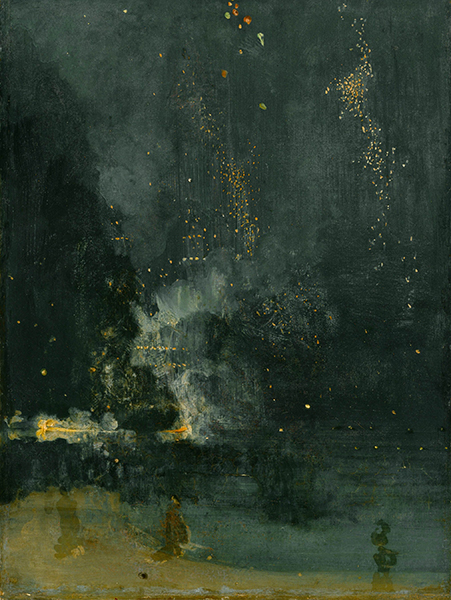
The original phrase l'art pour l'art was coined by the French poet Théophile Gautier (1811–1872), who used it in the preface to his 1835 volume, Mademoiselle de Maupin. However, he was not the first one to use this formulation, equally information technology was already present in the works by distinguished figures such as the philosopher and the founder of Eclecticism Victor Cousin, Benjamin Constant, political activist and writer on political theory, and the famed American author, Edgar Allan Poe. The concept was embraced by many French, British and American writers, and artists, and by proponents of the Aesthetic Movement such as Walter Pater; ane of the leading advocates of Art for Fine art'south sake was the American painter James McNeill Whistler.
The Aesthetic Purists Throughout The Fourth dimension
The 20th century was marked past the appearance of a new generation of modern artists willing to radicalize what the older Modernists, who grew into conservative academic painters, were unwilling to change. They explored virtuous representations aimed to express good moral values, desirable conduct, and noble sacrifice, all unacceptable to the radical modernists who considered them uncritical.
While the conservatives wished to maintain existing positions within the institutions, the younger modernists were disquisitional of political and religious institutions since they restricted individual liberties. The old ideas inherited from the Enlightenment were no longer valid, and the modify was only possible if all say-so was questioned - especially in the terms of the middle course. Therefore, the avant-garde blossomed, exploring political and social problems that the younger artists felt the urge to address.
Art For Art'southward Sake – A Matter of Privilege
Whistler himself believed he was confronting the tastes and ideas of the middle class, but this persuasion speedily turned to the neutralization of any particular content and led to formalism – the need to address issues solely reserved for the art-making process. That is how the quest of investigating the meaning and purpose of art in regards to society became easily ignored.
This 19th-century bohemian'due south credo was disputed past many, from John Ruskin to the figures who were inclined to the Marxist approach to art-making. Already in 1872, the writer George Sand claimed the Art For Art's Sake is an empty phrase while insisting that the artists are obliged to communicate their deeds with a wider public. The distinguished German philosopher Walter Benjamin critically examined the slogan in his iconic 1936 essay The Piece of work of Art in the Age of Mechanical Reproduction.
Although widely debated, Art For Art'south Sake was by and large embraced by Abstract artists who were expressing themselves in a closed formalist framework that was separated from the real world. Such a paradigm was extended on the calibration from the interwar abstraction through the post-war tendencies such as Abstract Expressionism and Color Field painting to Minimalism and some afterwards artistic styles.
Despite the fact various art movements active during the kickoff half of the 20th century attempted to deliquesce the formalist tendencies, the fine art system itself (governed by the bookish art historians and critics, and the sprawling art market interested in profit) somewhen captivated all subversive inclinations and made the Fine art For Art's Sake into a rather neutral activity.
Looking from the contemporary perspective, the Art for Art's Sake approach is retrograde and does nothing in establishing a dialog with a wider community every bit information technology addresses only the ones affiliated with arts. Although cherished by numerous artists, fine art historians, and the art marketplace, the Art For Art's Sake is very problematic in the terms of grade.
Since the backer matrix not only tends to maintain the class discrepancy but rather to deepen it, this paradigm becomes fifty-fifty more than questionable, non to mention the fact it means nothing in other cultural environments, being an exclusively Eurocentric cosmos.
Featured epitome: Marcel Duchamp - Fountain, 1917. Paradigm by art@aditi via Flickr.
Source: https://www.widewalls.ch/magazine/art-for-arts-sake
0 Response to "What Artist Believed Art Should Be Noble and Public"
Post a Comment