How Do You Know if Youre Getting Dementia
Why eating colourful food is salubrious
(Image credit:
Mehmet Emin Menguarslan/Getty Images
)
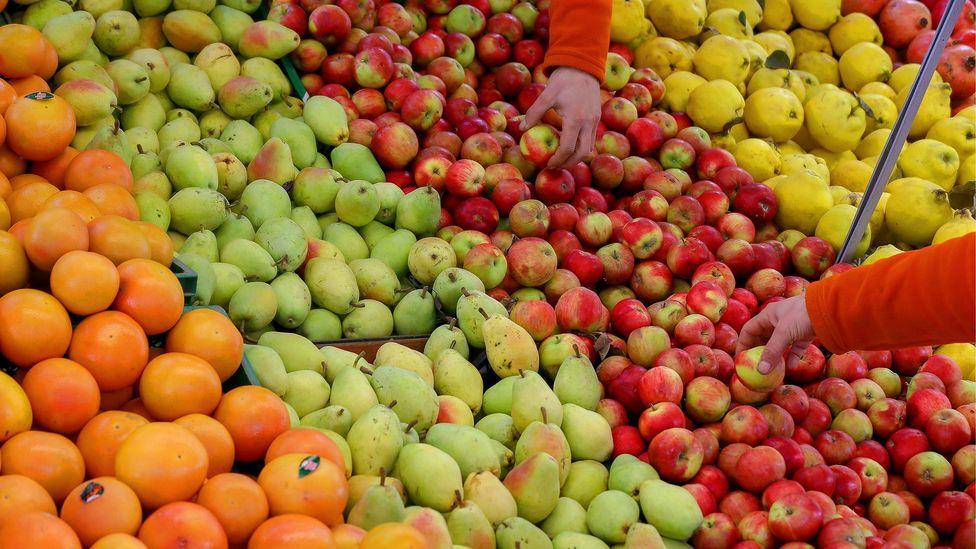
Eating all the colours of the rainbow can help boost encephalon health and reduce the take a chance of eye illness.
M
Most of united states of america are faced with the same choice numerous times a twenty-four hour period: what to eat. Along with price, accessibility and preference, we'll often employ a food'south healthfulness to help us make a decision.
Just when we zoom out to inspect our overall diets, how do we know nosotros're getting the nutrients nosotros demand?
It's widely accepted by researchers that we need a varied nutrition, and that one way to do this is by eating all the colours of the rainbow. But is colour the best guide to getting all the nutrients we demand?
The proof may exist in the Mediterranean nutrition, which contains a lot of fruit, vegetables and salubrious fats such as extra virgin olive oil, and is oftentimes rated the healthiest diet by scientists.
Information technology's no coincidence that the nutrition is packed with unlike colours, says Francesco Sofi, associate professor of clinical nutrition at the University of Florence.
"Eating a traditional Mediterranean diet means yous eat unlike nutrients and phytonutrients," he says. Phytonutrients are small chemical compounds produced by plants that help the states to digest larger nutrients and also play a role in removing toxins from our bodies.
"However, the diet doesn't e'er contain every colour – it depends on the flavour, as followers of the diet eat seasonally and locally, and abound their own fruit and vegetables."
Really, he adds, the colours are no different to other vegetable-based diets, such as the vegetarian nutrition. There are as well other reasons the Mediterranean diet is among the healthiest. Mediterranean populations traditionally eddy, rather than fry, their vegetables, which preserves nutrients, Sofi says.
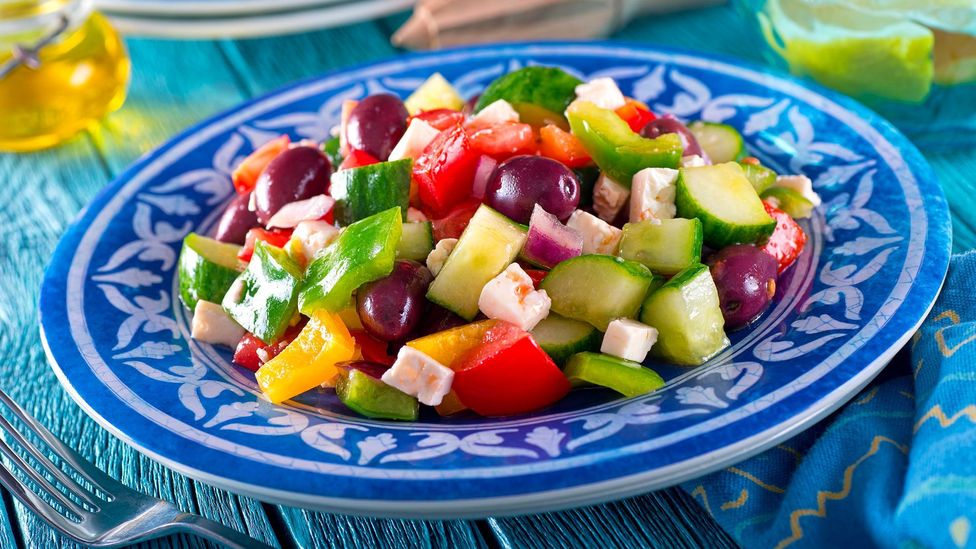
The Mediterranean nutrition, which contains a lot of fruit, vegetables and unsaturated oils, is frequently rated the healthiest by scientists (Credit: Alamy)
Merely the diet'southward abundance of fruit and vegetables can't be ignored. The health benefits of a diet rich in fruit and vegetables on our encephalon and middle are among the most consequent findings within nutrition science, says Deanna Minich, functional nutritionist and adjunct kinesthesia at the University of Western States in Portland, Oregon.
Eating lots of colours may lower your gamble of missing out on all vital nutrients.
"If we're missing a colour of the rainbow, we may exist missing a function of that nutrient," says Minich.
This is because plant foods incorporate thousands of natural compounds chosen phytonutrients, including carotenoids and flavonoids, which have anti-inflammatory benefits. And different coloured plants come with different benefits.
Blue and purple foods, including blueberries, have a high content of the found paint anthocyanin, which has been linked to lowering the chance of eye disease and type two diabetes. Flavones, which requite foods a yellow colour, may reduce the adventure of middle disease.
"Certain found pigments travel to sure parts of the body and have residency there," Minich says. "For example, lutein is institute in a multifariousness of yellowish and green foods, and travels to the macula at the back of the eye, where it may help reduce the gamble of macular degeneration."
Some studies show flavonoids may ameliorate brain health, by blocking neurotoxicity in the brain, which is associated with Alzheimer's disease.
After following the diets of 50,000 people for more than than twenty years, Tian-shin Yeh, research boyfriend in epidemiology at Harvard TH Chan Schoolhouse of Public Health, found that those who consume more flavonoid-rich foods, including oranges, peppers, celery and grapefruit, accept lower levels of cognitive pass up and dementia.
While in that location's currently no cure for dementia and cognitive impairment in later life, Yeh says, eating more flavonoid-rich foods can help to lower the risk. However, participants who saw the about benefits were those who'd consistently been eating a flavonoid-rich diet for 20 years.
It's never too late to incorporate these foods into your nutrition and benefit from flavonoids, Yeh says.
Eating a colourful diet, Yeh says, can also assist people avoid possible adverse effects of eating too much of one nutrient.
"Nutrient is very complex. For example, research has plant that orange juice is associated with a lower risk of cognitive decline, but likewise much intake is associated with blazon two diabetes," she says. Although, this is because of its saccharide content, not flavonoids.
You may also like:
- How eating fish affects your health
- Is fresh food better than frozen?
- How to decode a food label
But eating a rainbow diet may also be complex, says Victoria Taylor, a senior dietitian at the British Heart Foundation.
"It could be really tricky to go every colour every mean solar day – you could tie yourself in knots," she says.
We besides need to eat from other food groups to get all the macronutrients nosotros need, such as protein, she says.
All the same, Minich argues that the rainbow nutrition isn't express to fruit and vegetables, but includes other natural foods, such equally herbs, spices, legumes, basics, seeds, wholegrains, and even tea. She also considers white food equally part of the rainbow diet, including tofu, which contains numerous dissimilar isoflavones, which have been associated with a lower gamble of heart disease and some cancers, likewise as cognitive decline.
Eating a multifariousness of colours could hateful we consume more fruit and vegetables overall. One study plant that prompting people to eat a colourful repast increased their consumption of healthy food.
"If you're eating the same fruit, you'll become satisfied, only if you have a plate of unlike fruit and vegetables that vary in color, you're probable to want swallow for longer," says Rochelle Embling, PhD student at Swansea University, who wasn't involved in the study.
"This effect is specific to the food being eaten, so after a meal, dessert remains desirable because it has different sensory characteristics," Embling says.
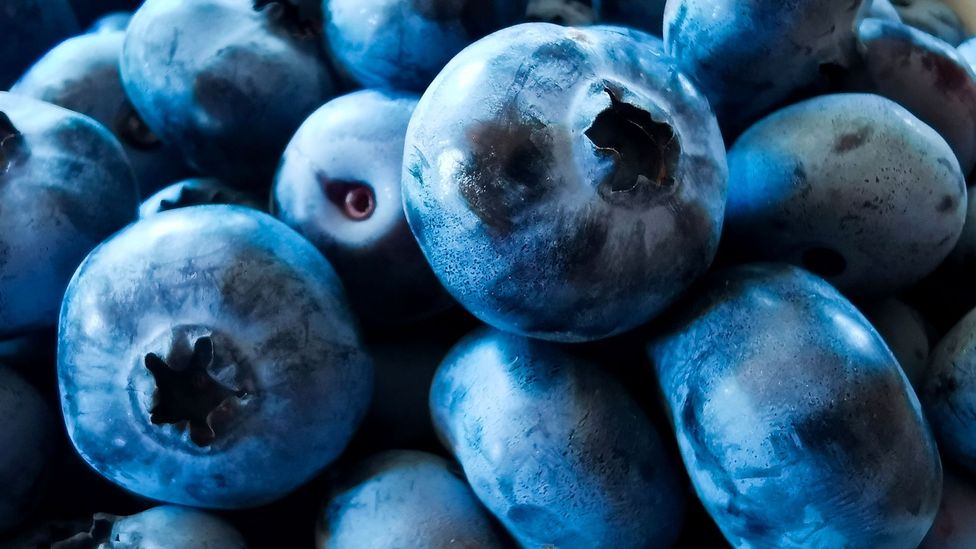
Blueberries contain anthocyanin, which has been linked to lowering the adventure of heart disease (Credit: Beata Zawrzel/Getty Images)
But eating a more colourful diet may also increase the gamble of overeating unhealthy food. Embling has constitute that we're more than likely to eat more pizza when it has lots of unlike coloured toppings. She advises eating varied colours for fruit and vegetables merely opting for a smaller color palette for more indulgent foods. Information technology's too worth noting that bogus colouring in foods, such as cake and sweets, sadly don't count towards a varied healthy nutrition.
At that place are other ways, aside from color, to get a range of nutrients and phytonutrients from your diet, researchers say, such as paying attending to taste. I study found that participants who ate bitter and strong-tasting vegetables over 12 weeks had lower blood pressure and blood carbohydrate at the terminate, considering of their fibre content and the range of phytonutrients they incorporate.
The study states: "Root vegetables and cabbages are rich sources of antioxidants such as flavonoids, carotenoids, and other bioactive phytochemicals; ingesting these combined in whole foods may let for synergistic activeness, thus providing enhanced health-promoting effects."
In other words, they may be healthier than the sum of their parts.
"The colours of food are very important for our diet, simply and then are flavours, especially [those of] bitter foods, such as rocket, kale, celeriac and green tea," says Minich, who wasn't involved in the study but agrees with its findings and emphasises the benefits of these compounds reacting with each other to further do good our health.
Another option is to consider which parts of the constitute you're eating, says Yeh.
"Turnips and swedes have more similar nutritional values because they are both the root; whereas the nutritional values for cabbage and swede are not that similar because one is the leaf and the other one is the root part of the establish."
Although, Yeh concedes, "Because the colours may be the easiest way to guide the consumers."
Join one million Future fans by liking united states on Facebook , or follow u.s. on Twitter or Instagram .
If you liked this story, sign up for the weekly bbc.com features newsletter , called "The Essential List". A handpicked selection of stories from BBC Future , Civilization , Worklife , Travel and Reel delivered to your inbox every Friday.
Source: https://www.bbc.com/future/article/20210917-why-eating-colourful-food-is-good-for-you
0 Response to "How Do You Know if Youre Getting Dementia"
Post a Comment